

Modern mail service in Chicago is highly developed and serves a large number of people. However, things were quite different in the past. We will discuss its history and development in detail on chicago-future.com.
Founding the Office
The story begins in the distant year of 1831, when the first public post office appeared in Chicago. Fur trader Jonathan Bailey was appointed as the first postmaster. Prior to this, letters and newspapers arrived at the military post at Fort Dearborn, from where they were delivered by soldiers and officers along a route connecting Fort Dearborn with Fort Wayne (Indiana) and Green Bay (Wisconsin). In 1836, postal contractors, utilizing subsidies to encourage passenger transport, opened a stagecoach service. By 1837, the Chicago Post Office had become a distribution hub, signaling the rapid expansion of the settlement and its significance in the national postal network.
The most influential people in the city gathered at the local post office to read newspapers, catch up on fresh market information, and discuss pressing matters. In the 1850s, private letter carriers supplemented the limited delivery options provided by the government. However, most postal customers had no choice but to visit the office personally to pick up their mail. The situation fundamentally changed in 1864 with the introduction of free city delivery and the consequent emergence of the postman.
Mail Transportation by Rail
Throughout the 19th century, the distribution of postal jobs and contracts was one of the primary forms of political patronage. Postmasters were often newspaper editors who had close ties to the ruling political party. For example, during the Civil War, Chicago’s postmaster was John Scripps, concurrently the founder of the Chicago Tribune newspaper and the author of Abraham Lincoln’s campaign biography.
Chicagoans played a crucial role in shifting mail sorting from distribution centers to moving railway cars. This innovation was termed the “Railway Mail Service” (RMS). In 1864, Chicago postal administrator George Armstrong created the first railway mail car, which ran on the route between Chicago and Clinton, Iowa. Although William Davis, the assistant postmaster in St. Joseph, Missouri, had surpassed Armstrong in some respects, Armstrong received recognition and soon became the first Superintendent of the Railway Mail Service. Notably, this service was a key element in the communication infrastructure of the late 19th century.
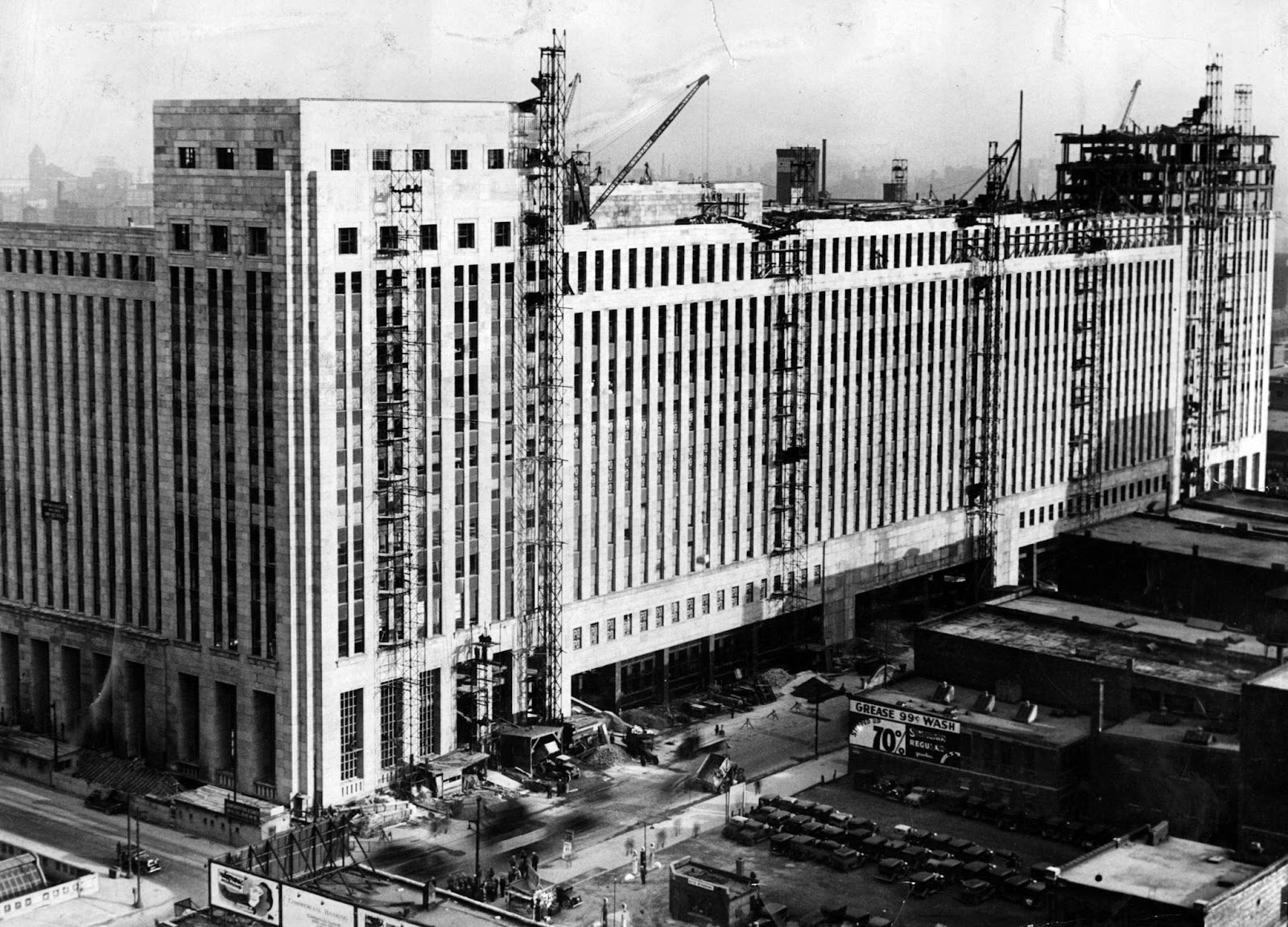
Chicago long remained the center of the country’s railway mail network. To speed up the movement of mail across the continent, George Bangs launched the specialized Fast Mail train between New York and Chicago in 1875, which became one of the technological wonders of the time. Bangs soon replaced Armstrong as the General Superintendent of the RMS. A major milestone in mail sorting was the construction of a huge postal terminal in the city in 1924, which became one of the largest in the world. In the 1930s, the Chicago Post Office, occupying over 2 million square feet, handled 35 million letters and 500,000 bags of mail and parcels every day. Dozens of trains delivered mail to and from the building, while over 5,000 trucks entered and exited daily. Foreshadowing later developments, postal helicopters used the roof as a landing pad in the 1940s and 1950s. In addition to postal facilities, the building housed offices for administrative staff, a cafeteria, a restaurant, and a bank.
Mass-market companies like Sears and Montgomery Ward relied on the Chicago post office to distribute their catalogs and magazines, which featured extensive advertising. When the Parcel Post service was created in 1913, merchants became dependent on it for shipping their goods. Thus, Chicago’s postal system and the federal government played a direct and sustained role in the city’s economy.
Innovation: Airmail
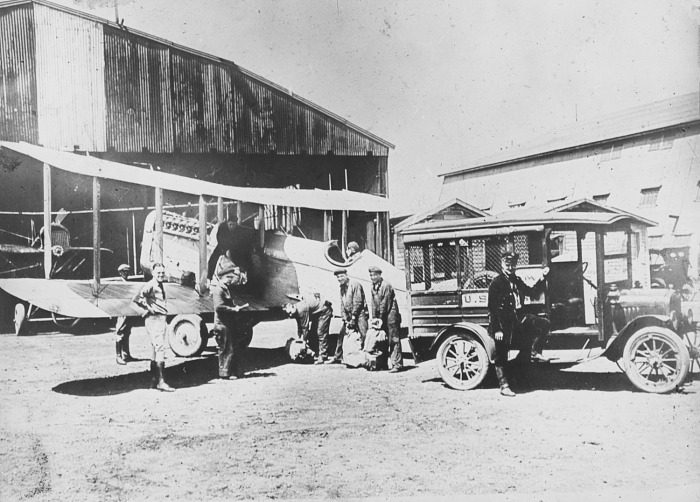
In 1918, airmail service began operating between New York and Chicago. By 1920, Chicagoans could, for an additional fee, send letters by air from Chicago to most major urban centers across the country. For several years, airmail pilots flying from Chicago landed at an airfield in the suburb of Maywood. Among the early airmail pilots was Katherine Stinson, an aviatrix famous for her courage and skill. Perhaps the most famous pioneer of this aviation was young Charles Lindbergh, who worked as an airmail pilot on the Chicago-St. Louis route before his famous transatlantic flight.
For most of the last century, the Chicago Post Office, along with New York’s, were among the busiest in the country. In the 1890s, it handled one-sixth of all the nation’s mail. By 1905, it employed 8,000 clerks and 18,000 letter carriers. For a long time, the office employed many African Americans, who constituted 65% of the staff in 1966. That same year, Henry McGee became the first African American appointed Chicago Postmaster, concluding a 37-year career in the postal service.
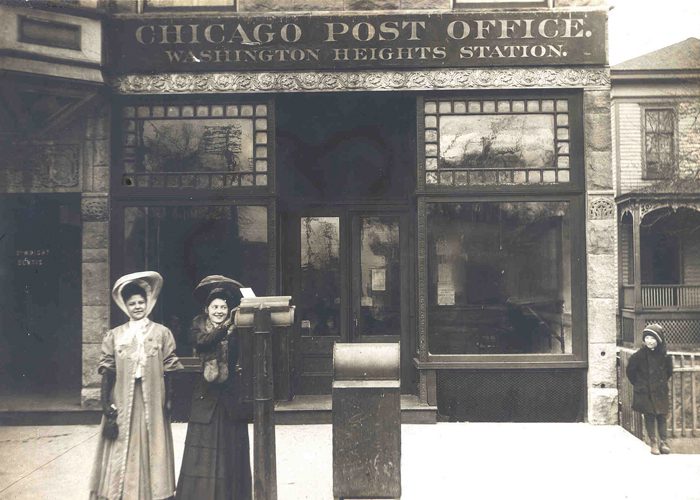
The first Chicago Post Office was located in a store near the Chicago River in the Fort Dearborn area. Its building was constructed in 1860, but unfortunately, it burned down after the Great Fire in 1871. From 1879 to 1896, the first office was housed in a substantial government building in the then-fashionable Second Empire style. In 1905, the post office moved into an even more monumental Beaux-Arts style building. It had long been a city landmark, and upon its erection, it was called one of the largest and most expensive structures ever built in the city. It was demolished in 1965. In the 1960s, the Chicago Post Office introduced automated systems, and in 1996, the construction of a new central office was completed.
For most of the 20th century, the Chicago Post Office was the largest mail distribution center in the world. At times, sorting methods could not keep up with demand. In the fall of 1966, a sudden surge in mail volume halted the office’s operations for 3 weeks, delaying the delivery of 10 million items. This infamous episode triggered a Congressional investigation and hastened the full-scale reorganization of the postal system. Its culmination was the creation of the U.S. Postal Service in 1971.
Mail Order Retail
Mail order retail quickly became Chicago’s biggest business. By 1872, Chicago companies dominated direct sales to consumers nationwide, using catalogs and mail delivery. A prime example is Montgomery Ward & Co., the world’s first giant enterprise specializing in mail order goods. It was opened in Chicago in 1871 by Aaron Ward, who also became the head of the firm. Montgomery Ward & Co.’s products specialized in the agricultural and farming sectors. The enterprise quickly gained popularity because Ward initiated a money-back policy. By the 1880s, the growing volume of catalog orders led Ward to hire over 100 Chicagoans as clerks. At that time, Aaron’s company became the leading postal user in the US, and its annual sales soared to approximately $7 million.
In the 20th century, mail order retail, led by Chicago giants, became a major sector of the American economy. Millions of people purchased a wide range of goods through it. In the early 21st century, the city continued to be a leading center for the postal industry.