

The Willis Tower, formerly known as the Sears Tower, is an unmistakable landmark dominating the Chicago skyline. Towering at 1,450 feet (442 meters), it stands as one of the world’s tallest skyscrapers. Additionally, the Willis Tower is home to a massive array of television and radio antennae. We’ll dive deeper into the history of this monumental structure on chicago-future.com.
Towering by the Numbers
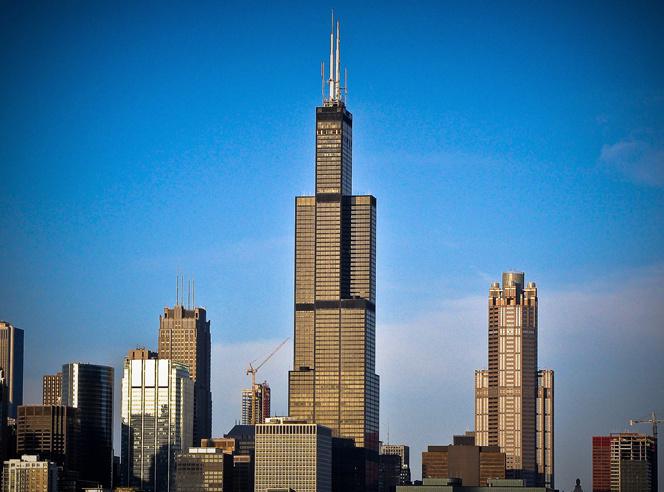
- The Willis Tower measures 1,451 feet (110 stories) without accounting for the rotating antennas and their support structures.
- The building’s main roof is aligned with the 109th floor.
- The Willis Tower is currently the 12th tallest building in the world.
- With a total area of over 4.3 million square feet, the tower features approximately 16,100 windows.
- Construction lasted three years and was officially completed in May 1974.
- Over 100 companies operate within the building, and since 2018, the largest tenant is United Airlines, whose offices span about 20 floors.
Design and Construction of a Modern Marvel
The Willis Tower is a brilliant example of outstanding architecture and urban progress. For over two decades, from 1973 to 1998, it held the title of the world’s tallest building. It’s worth noting that the tower officially opened in 1973, even though its final construction was completed in 1974.
The construction of the Sears Tower was financed by Sears Roebuck & Co., costing an estimated $150 million. The team of Colombian-Peruvian architects, including Bruce Graham, designed the building using a bundled tube concept: nine square tubes grouped in a 3×3 matrix, creating a square base with a 225-foot side. All nine tubes rise to the 50th floor. The northeast and southwest tubes extend to the 66th floor, while the north, east, and south sections end at the 90th floor. The remaining west and center tubes reach the 108th floor.
The Sears Tower pioneered numerous innovations. This structural system significantly influenced the design of future skyscrapers. The building features black bands near the 29th, 64th, 88th, and 104th floors. These serve to ventilate the building’s life-support systems and discreetly conceal the structural “belt trusses.”
In February 1982, two television antennas were added to the building, increasing its overall height to 1,707 feet. The western antenna was extended in 2000, bringing the tower’s total height to 1,729 feet.
In 1971, Sears, Roebuck & Company and city officials developed the project and laid the first steel. Notably, plans did not originally include installing television or broadcast antennas. However, pressure from various retailers—whose television receiver sales were suffering due to severe ghosting problems caused by the presence of the Sears Tower—ultimately led to their installation soon after.
To accommodate this, two 90-foot-tall, 12-foot-diameter cylindrical bases were added to the design, allowing local television stations to install their antennas in the future.
An interesting fact is that Sears, Roebuck & Company took fire safety to a new level by constructing a fully sealed building. Despite the fact that regulations at the time did not mandate a sprinkler fire suppression system, the Sears Tower was equipped with one from the very beginning of construction. In total, the tower has nearly 40,000 sprinkler heads.
The First Tenants

Upon its opening, the Sears Tower housed the headquarters of Sears, Roebuck & Company—then the world’s largest retailer. The tower’s strategic location, bordered by Franklin Street, Jackson Boulevard, Wacker Drive, and Adams Street, ensured convenient access to expressways and train lines for the company’s 350,000 employees. In 2009, the London-based insurance broker Willis Group Holdings acquired the naming rights to the tower for 15 years and leased three floors, occupying over 140,000 square feet of office space. Following this agreement, the building was officially renamed the Willis Tower.
The Humble Start of Television Broadcasting
For the first two years, only WLS-TV-7 and WTTW-TV-11 broadcast from the Sears Tower site. The stations utilized a side section of the tower, attached to the west cylindrical base. This setup allowed them to cover the land (as opposed to the relatively uninhabited Lake Michigan) with directional VHF television antennas. The stations operated from these antennas starting in 1972, and they remained useful until the transition to digital television.
For 11 years, television broadcasters couldn’t decide what to do next. RKO and General Radio, the licensee of WFYR-103.5, cleared the path for the development of a temporary FM antenna mast in just two years. Among the three broadcasters who moved into the Sears Tower, WFYR, RKO, and WXFM had the worst antenna locations. Therefore, George Capalbo, Vice President of RKO Radio, struck a deal with Eric Paul, who was responsible for the tower’s roof. However, this didn’t immediately change the situation, as there was no one willing to finance the vertical construction above the cylinders.
Finally, after two years of meetings, Sears, Roebuck & Company conceded in the winter of 1974 and installed FM radio antennas. Four antennas were leased for a short term, and their installation was intended to be temporary.
Regardless, this opened the door for four FM broadcasters: WLAK 93.9, WCLR 101.9, WFYR 103.5, and WXFM 105.9. Their teams included John Borkowski, Gary Schroeder, Don Coleman, and others.
The nominal 12-inch mast consisted of 4-foot and 10-foot flanged sections, stacked and secured to I-beams welded to the internal walls of the west cylinder. Then, four antennas were connected using a temporary single Harris circularly polarized ring for each station. This method successfully reduced cross-coupling and minimized the need for expensive notch filters.
Sherwin Esrow handled the design of the poles and beams. Don Goodell served as the contractor. However, the local metalworkers’ union closely monitored the work, making progress intermittent. The price of the work kept changing mid-project, and more funds were continually required. This was because the crew constantly had to contend with interference issues.
Soon after, the City of Chicago mandated that all antennas on the Sears Tower site be enclosed in a radome to control ice buildup. All stations operated with B ND class antennas, except for 105.9, which used orientation and reduced power to fit the narrow spacing with WLNR 106.3.
Battling the Elements

Lightning was a major issue for the FM antennas located on top of the tower, 1,530 feet above the ground. As previously mentioned, the mast consisted of four segments and was painted in the shop with multiple layers of acrylic paint. Initially, the bolted flanges did not ensure a reliable electrical connection, allowing lightning to penetrate the 3-inch feeder lines.
After a while, specialists welded each flange and added a dedicated grounding conductor from the lightning rod to the building’s steel structure. These measures helped reduce damage from lightning strikes. Nevertheless, they still faced future ruptures in the feed line along the tower section, as well as the destruction of the radome. In 1979, a powerful lightning strike caused a fire, resulting in serious damage to the power lines.
Today, the Willis Tower houses offices for a large number of companies and an observation deck, which is visited by thousands of people daily.