

In the heart of Chicago, at 806 North Michigan Avenue, amidst the glittering shops and neon signs of the “Magnificent Mile,” stands one of the most famous historical landmarks in the United States—the Chicago Water Tower. Built in 1869, this water tower survived the Great Fire of 1871 and became a living testament to the city’s transformation from ashes into a world-class metropolis. Read more at chicago-future.
History of the Tower
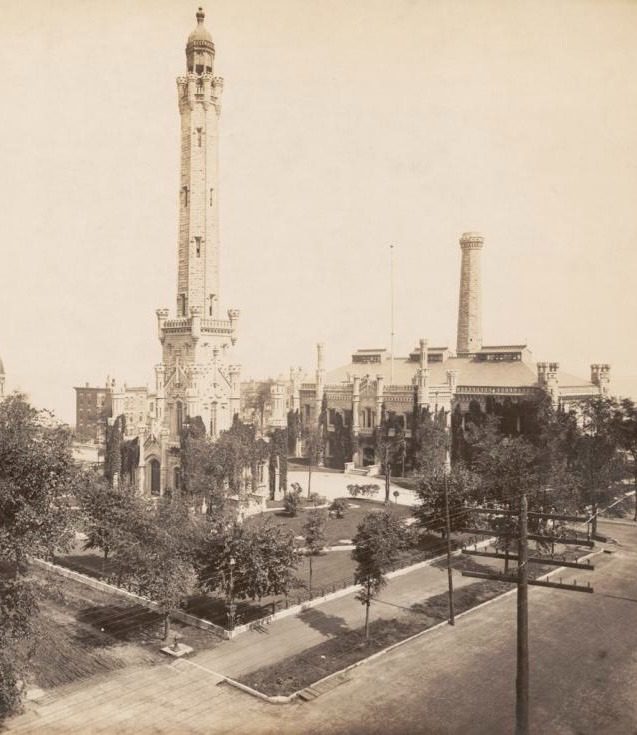
In the first half of the 19th century, Chicagoans drew their water directly from the lake or bought it from water carters. As the population grew, the city faced a severe problem: water pollution and outbreaks of disease. In the 1850s, engineer Ellis Sylvester Chesbrough proposed a revolutionary project—to build a tunnel under Lake Michigan and create a new water supply system. His idea was mocked at first, but this very design made Chicago a pioneer in hydraulic engineering. To regulate pressure in the system, the water tower was built, housing a 42-meter (138-foot) vertical standpipe inside.
In 1867, the new pumping station and water tower—the system’s main components—opened at the corner of Michigan Avenue and Chicago Avenue. Architect William W. Boyington, known for his Romanesque and Gothic designs, gave the structure the appearance of a small castle, complete with turrets, arches, and crenellated walls.
In October 1871, when the Great Fire engulfed the city, the tower miraculously survived, though its roof burned. The pumping station failed, but the structure itself endured. It became the only public building to survive the fire in the disaster’s epicenter. Since then, the Chicago Water Tower has become a symbol of the city’s rebirth, its resilience, and its engineering progress.
The tower’s architect was William W. Boyington, a renowned Victorian-era architect. His vision was bold: instead of a typical utilitarian structure, he created a true Gothic castle.
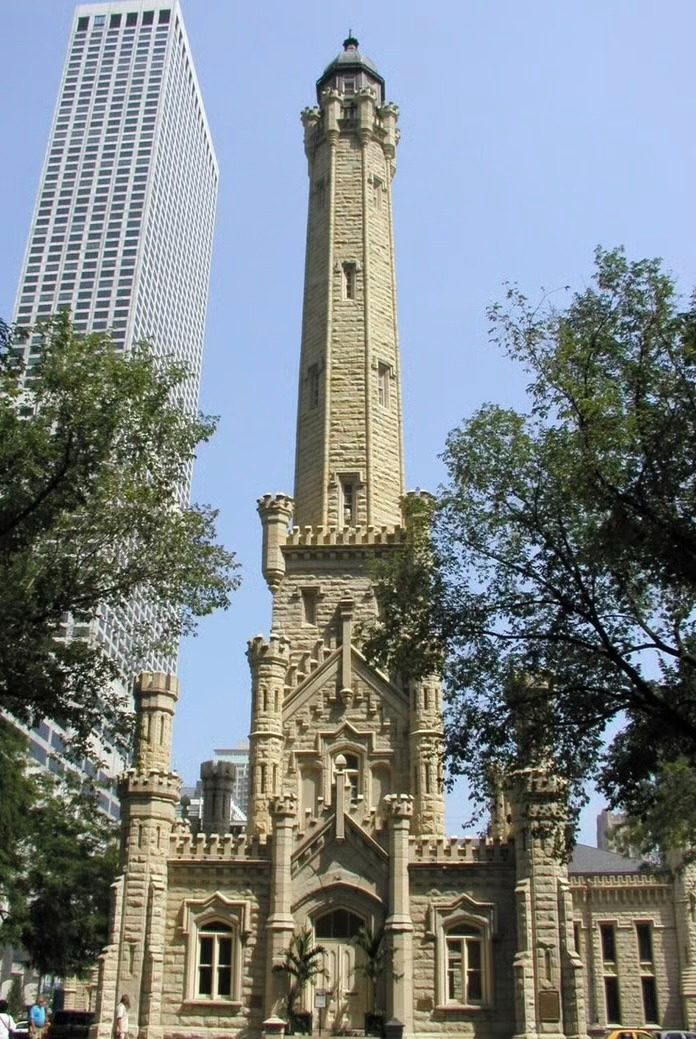
The building’s style was dubbed “Castellated Gothic.” The tower was built from creamy-yellow Joliet limestone. It stands 47 meters (154 feet) tall, its form resembling a medieval fortress with towers, loopholes, and battlements. Inside, a spiral staircase leads up to a former observation deck.
Although contemporaries, including Oscar Wilde, dismissed it as a “monstrous castellated fairytale,” today, the architectural community recognizes it as one of the most famous examples of 19th-century American Gothic Revival design.
Architectural Features
The Chicago Water Tower is built from yellowish Lemont limestone, a popular regional building material at the time. The structure reaches a height of 55 meters (180 feet), and it once housed a 42-meter (138-foot) pipe inside to help stabilize pressure in the water system.
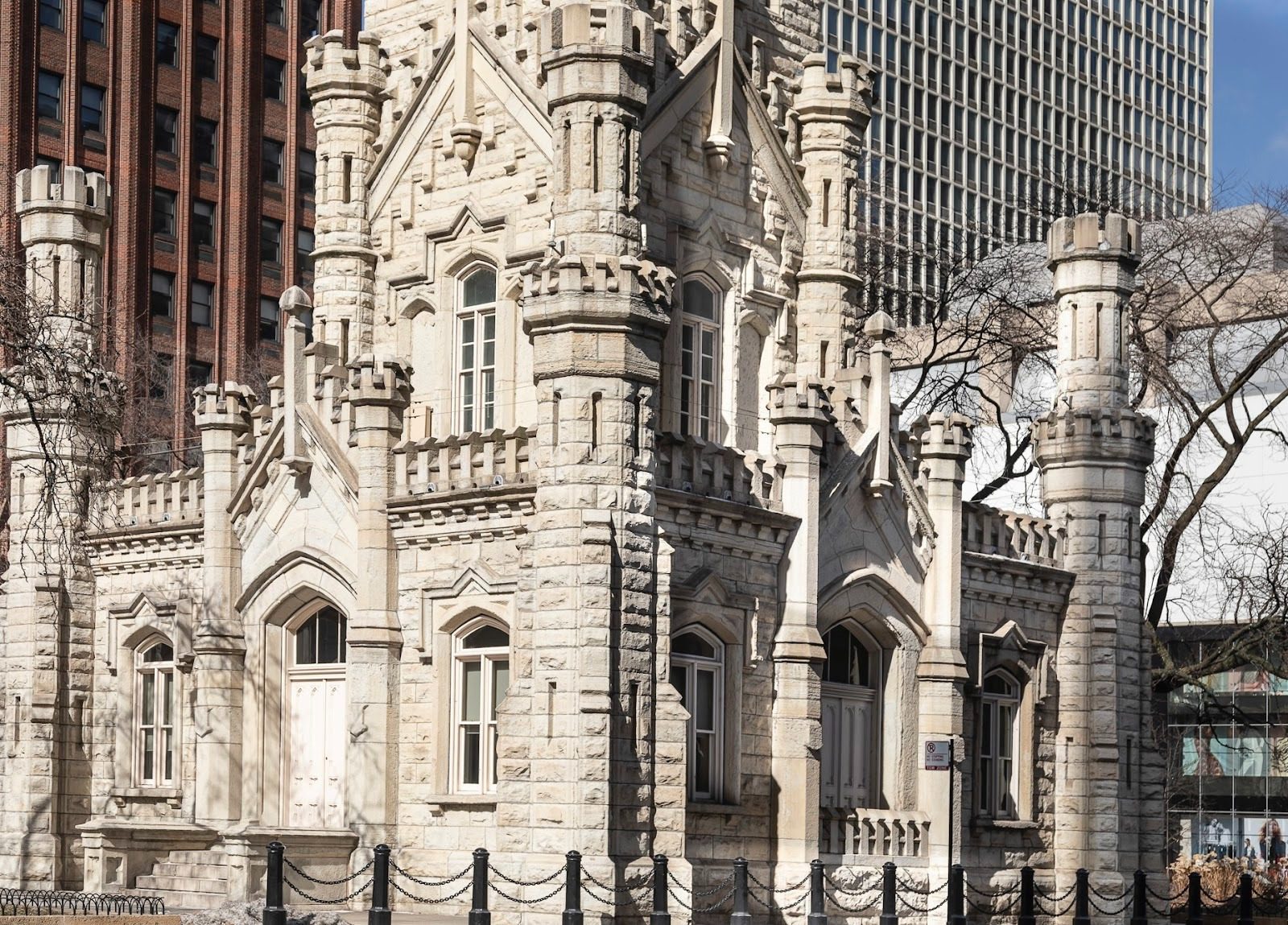
Architecturally, the building is in the Gothic Revival style—a combination of utilitarian function and decorative grandeur. The tower features:
- Crenellated parapets;
- Small turrets;
- Lancet-arched windows;
- Buttresses that emphasize its verticality.
The tower stands in a small plaza—Jane M. Byrne Plaza. In 1918, when Michigan Avenue was being widened, city officials even altered the road’s design to keep the Water Tower at the center of the cityscape.
Along with the tower, the complex includes:
- Chicago Avenue Pumping Station—the pumping station, which is still operational;
- Fire Station of Engine Company No. 98—a 1903 firehouse built in a complementary Gothic style;
- Seneca Park and Water Tower Park—cozy green oases that preserve the atmosphere of old Chicago.
Reimagining its Function
Despite its historical value, the tower repeatedly faced the threat of demolition. In 1906, it was targeted for removal as an “obsolete structure,” and again in 1918 for the widening of Michigan Avenue. However, the public and the Chicago Historical Society defended the building. The tower celebrated its 100th anniversary in 1967, and on October 6, 1971, the City Council officially granted it Chicago Landmark status.
After the tower lost its technical role, it was restored as a cultural site. It now houses the City Gallery in the Historic Water Tower, a small art gallery that exhibits works by local photographers, artists, and filmmakers.
The tower has become a part of the city’s tourist trail and a place where the past meets the present. It has retained its unique character even among the modern skyscrapers that have sprung up around it.
Cultural Significance
The Chicago Water Tower is not just an architectural monument but also an emotional symbol for the city’s residents. Its silhouette can be seen on souvenirs, stamps, and logos. In 1969, the structure was declared an American Water Landmark. Even the design of White Castle restaurants in the U.S. was inspired by the tower’s shape—its turrets, crenellated walls, and fairytale appearance.
The Chicago Water Tower is more than just a 19th-century engineering structure. It is a story of endurance, innovation, and beauty cast in stone. It survived a fire, urban transformations, and the changing of eras, and it continues to remind us that even utilitarian objects can become symbols of a city. For Chicago, this building is not just a landmark but a living metaphor for rebirth, still standing like a sentinel in the midst of a modern metropolis.