

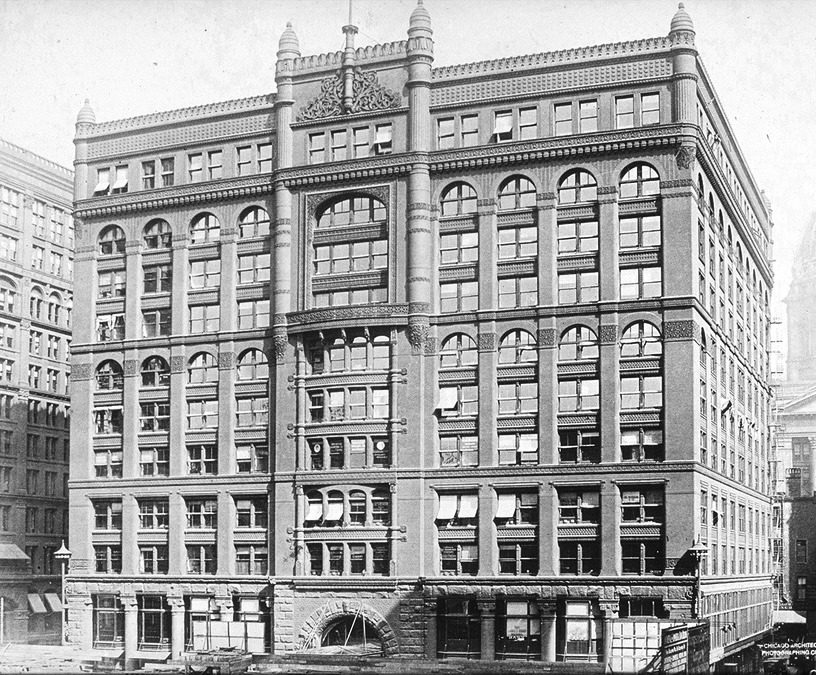
In the heart of Chicago’s business district stands one of the city’s most renowned historical buildings—The Rookery Building. This 12-story architectural masterpiece, designed by the legendary duo Daniel Burnham and John Root, became not only a symbol of the “Chicago School” of architecture but also an embodiment of late 19th-century technical progress. Its story is one of innovation, bold design solutions, and continuous restoration that has preserved the spirit of its era while giving the building new life. Read more at chicago-future.
The Construction Process
The Rookery’s story began in 1885 when the architects were commissioned to design a prestigious office building for the Central Safety Deposit Company. Burnham and Root met in 1872 while working as draftsmen at the architectural firm of Carter, Drake and Wright. Their partnership combined Burnham’s visionary nature with Root’s engineering ingenuity. By the time they created The Rookery, they had already found success with projects like the Montauk Block, Rialto, Commerce Building, Phenix Building, and the Art Institute of Chicago. Their task was to create not just a place for business, but a space that would symbolize Chicago’s economic strength after the Great Fire of 1871.
In 1888, The Rookery’s construction was completed. At eleven stories, its height was astonishing for the time. It was one of the grandest business centers in the world, combining technological innovation with aesthetic perfection. The architects located their own studio in the building. Their office, now known as the Burnham Library, became the birthplace of ideas that would define Chicago’s appearance for decades. It also housed the offices of Burnham & Root, the Illinois Trust & Savings Bank, and later, the Continental Illinois Bank, which remained a primary tenant for over a century.
The Building’s Name
The name “The Rookery” has several legendary origins. Some believe it was borrowed from the old city hall that stood on the site until 1885—which was neglected, “like a bird’s nest.” Others suggest the name came from crows that nested in the previous building’s walls, or from pigeons that flocked to the nearby fire station to peck oats from horse feed. Chicagoans, however, kept calling the new building The Rookery, much to the initial displeasure of its owners. Architect John Root embraced it with humor: he adorned the facade with sculptures of open-beaked rooks—a nod to the “noisy officials” who once worked in the old city hall.
Architectural Style and Construction
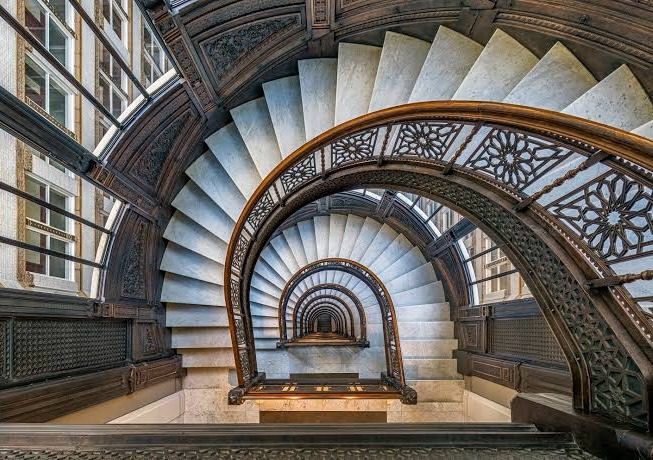
The Rookery became a transitional form in American architectural history—a combination of traditional masonry and a modern metal frame. The exterior walls were supported by massive brick columns, while the internal frame was made of steel and cast iron. Technical innovations included passenger elevators, electric lighting, and fireproof materials, making The Rookery a symbol of its era’s technological breakthrough.
“The Rookery” blends Romanesque and neo-Renaissance styles with Byzantine and Moorish influences. The facade is made of granite, red brick, and terra cotta, with the lower floors clad in polished stone, creating an impression of monumentality.
A key innovation was the “floating” foundation—a concrete platform with a metal framework that provided stability on Chicago’s marshy soil. The use of both cast and wrought iron marked a transitional phase toward the steel-frame structures that would soon give rise to the first skyscrapers.
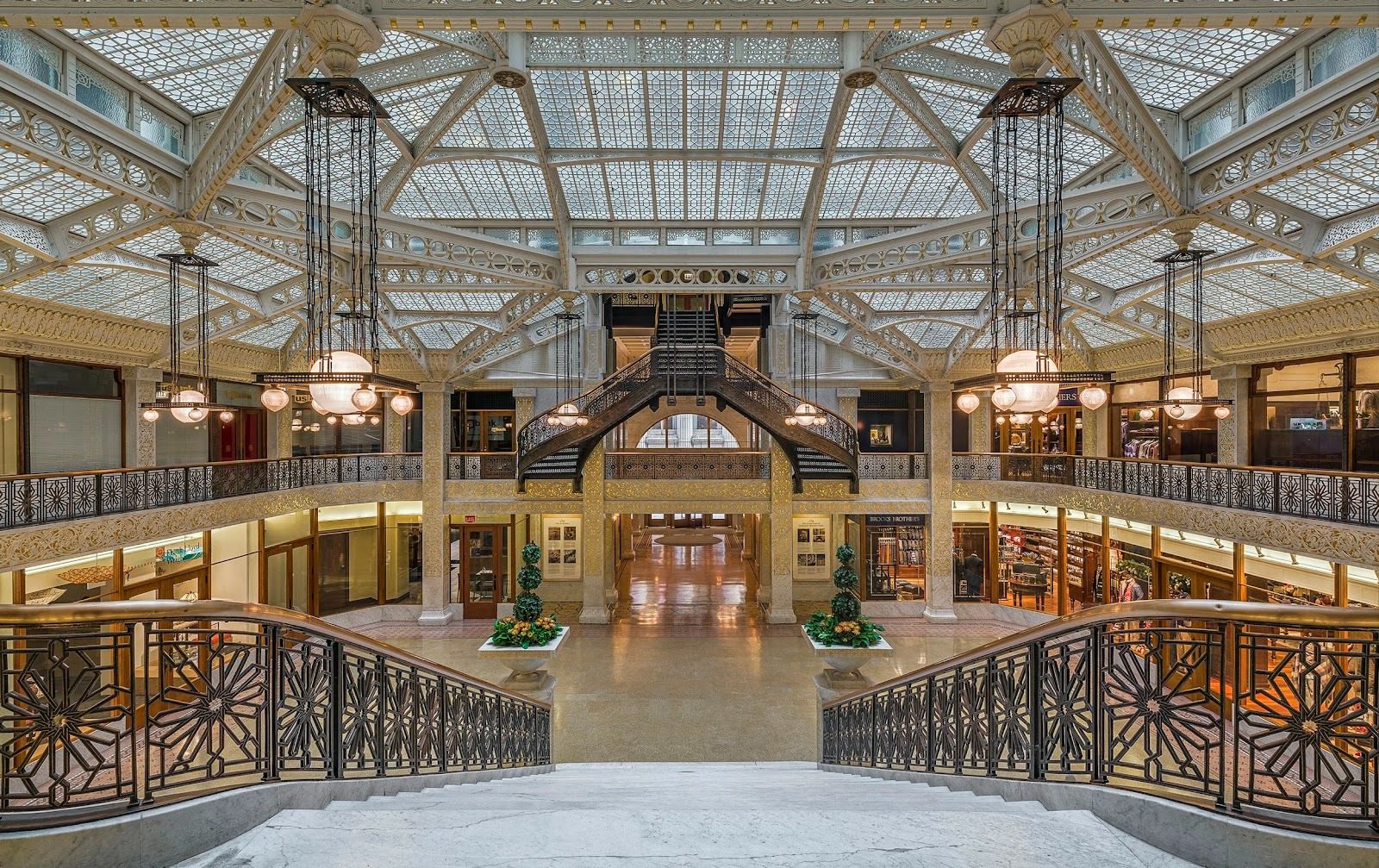
The building’s central feature became its two-story light court, which allows daylight to filter through 5,000 glass panels. It is here that one feels the harmony of space, metal structure, and natural light.
From 1905 to 1907, the interior was radically updated by Frank Lloyd Wright. He transformed the heavy iron construction into a light, almost airy space with flowing lines and modern lighting. Massive metal details were replaced with white marble featuring gold ornamentation in an Eastern style, and cumbersome light fixtures gave way to elegant bronze chandeliers with prismatic glass. He turned the interiors into a bright, elegant space that reflected a balance between innovation and respect for the past. His update became one of the most luxurious interior design projects of the early 20th century.
Restoration
In 1931, his student William Drummond undertook another renovation, adding Art Deco elements. He divided the lobby into two floors, replaced the double staircase, and adorned the space with marble engraved with bird motifs. Bronze doors with bird and plant reliefs, created by artist Annette Byrne, were installed on the elevators. However, these changes cost the building some of its light and openness—the light court became a darker space with its glass roof covered.
After the economic hardships of the 1970s, the building changed hands several times. In 1982, it was acquired by Continental Illinois Bank, which began a large-scale facade restoration. The next renovation, from 1989 to 1992, restored the building’s original brilliance and earned the architects at McClier Corp. an award from the American Institute of Architects.
When The Rookery was added to the National Register of Historic Places in 1970, it officially became part of Chicago’s cultural code. Just two years later, in 1972, the city granted it official landmark status, recognizing its unparalleled contribution to the city’s skyline.
In 1992, the most extensive restoration in The Rookery’s history was completed. Architects restored the building to its original grandeur, refurbished the famous Burnham Library, and added a twelfth floor that blended seamlessly with the classic facade. The following decades were a period of technological and environmental renewal. In 2014, The Rookery achieved LEED Gold Certification. This step confirmed that even historic architecture can meet modern sustainability standards.
In 2018, the building earned ENERGY STAR Certification, proving its ability to use resources efficiently and reduce greenhouse gas emissions. And in 2020, The Rookery achieved the WELL Health-Safety Rating—an international standard that assesses air and water quality, sanitation, and health safety for visitors and staff.
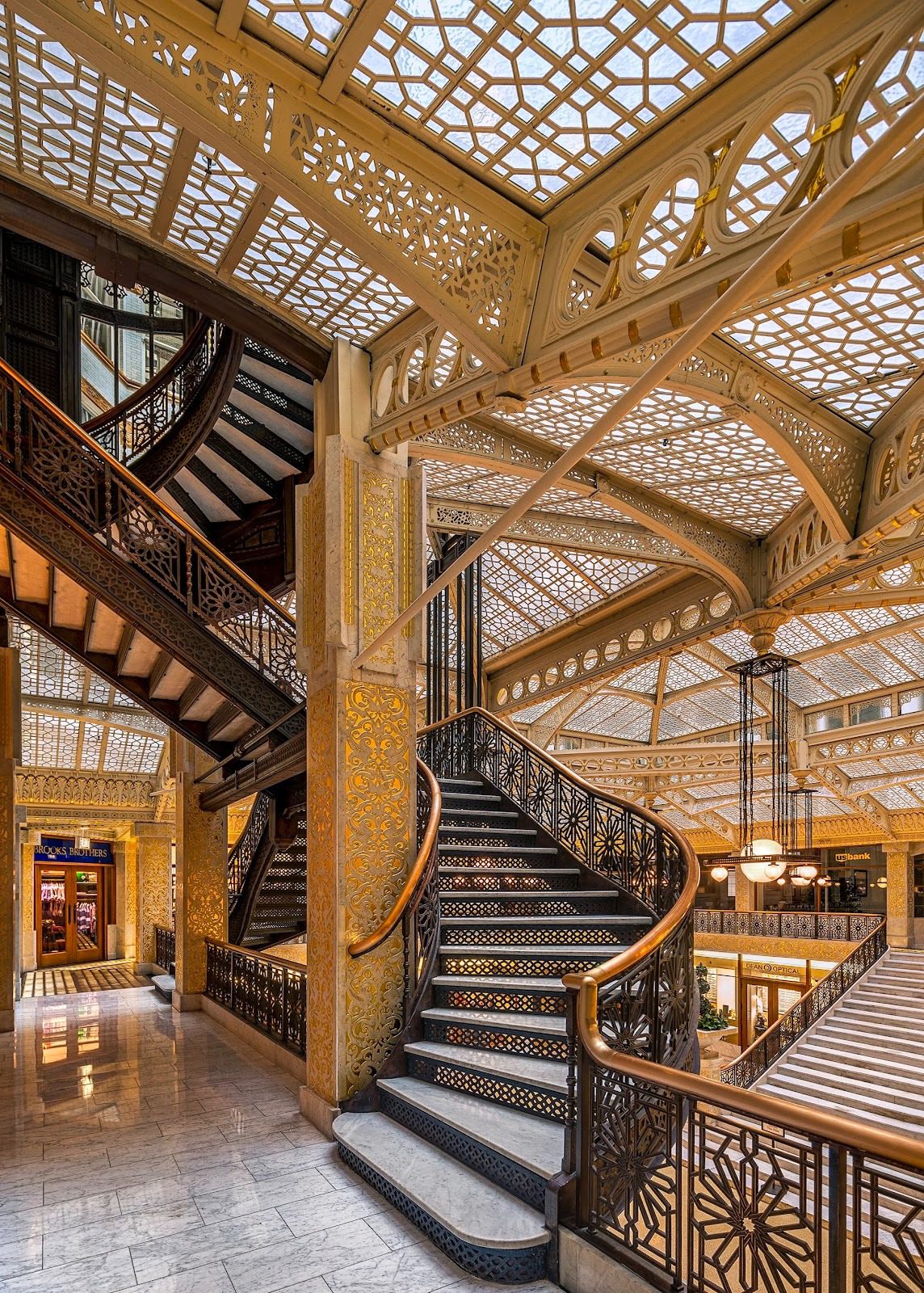
The Rookery Building is not just an office building but also a National Historic Landmark. It was listed on the National Register of Historic Places (1970) and declared a Chicago Landmark (1972). The building has served as a filming location for movies like “The Untouchables,” “Home Alone 2,” and “Transformers: Dark of the Moon.” Hundreds of tourists visit it daily, and the Frank Lloyd Wright Trust conducts tours, unlocking the secrets of this architectural legend.
This is not just an office structure. It is the living history of Chicago architecture, combining 19th-century ingenuity, 20th-century modernist aesthetics, and 21st-century technology. It remains a symbol of how innovation, art, and respect for heritage can coexist in one building for over 130 years.